Alaia
How an ancient Hawaiian board changed everything I thought I knew about surfing.
The Alaia Story
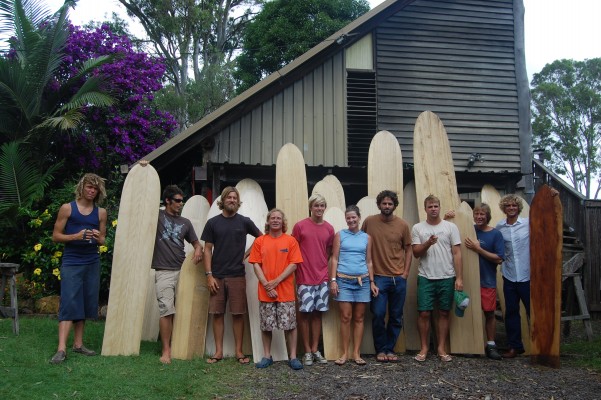 The Present Crew, with Thomas Campbell
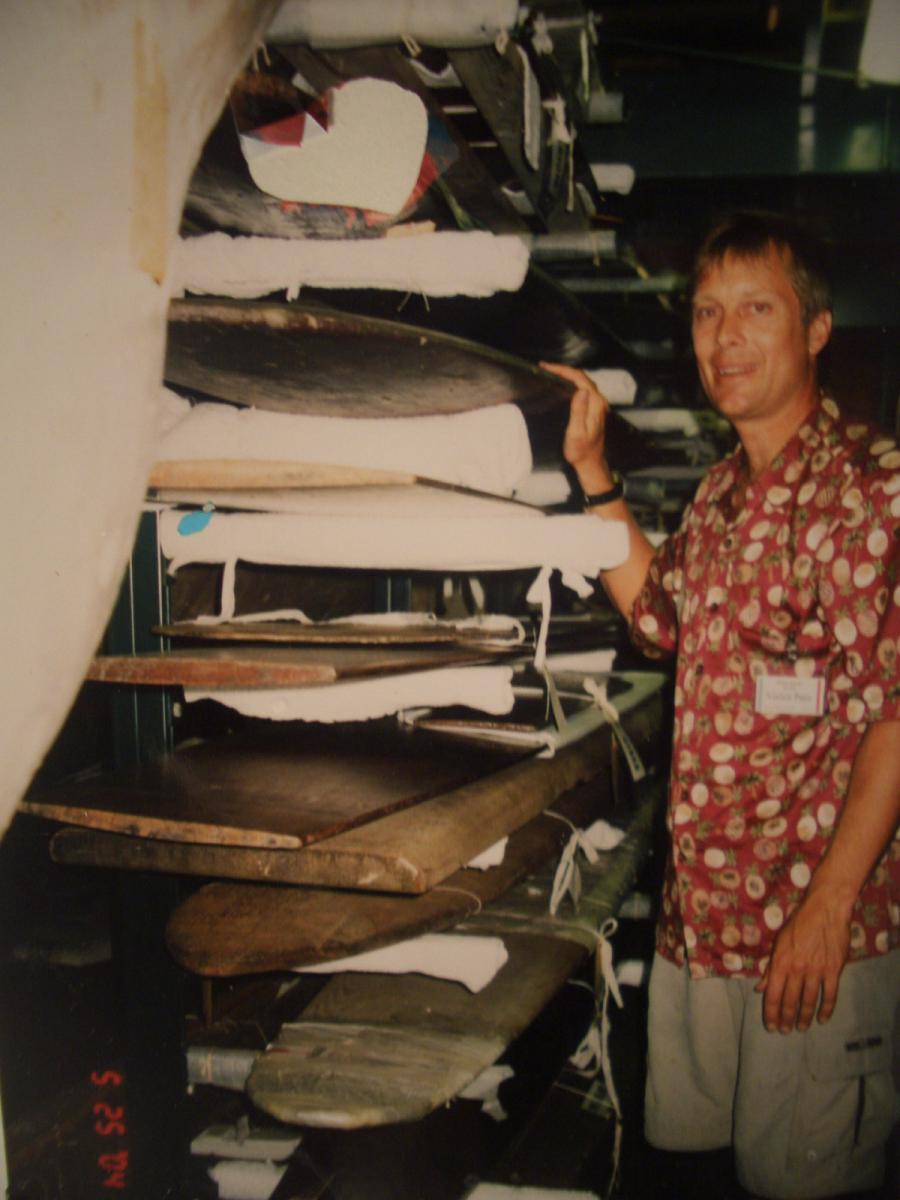 Visiting ancient boards at The Bishop Museum, Honolulu, Hawaii in 2004. Note: the perfect shaped alaias
A brief history of Tom Wegener and the Alaia Revolution
The Alaia is a thin wood surfboard used by the ancient Hawaiians. Although it was their most popular surfboard for hundreds of years, it virtually disappeared from history for the entire 20th century (1900-2005). Because the surfboard is very thin, never more than one inch or 24mm thick, it is difficult to paddle and without fins it was thought that it could not angle across a wave. The alaia was forgotten by modern surfers.
I went to visit the ancient surfboards in the Bishop Museum in April 2004 and I was astonished by the perfection of the shapes. Having made many wood surfboards, I could see that each board was a masterful product specifically made custom for the surfer. I had no idea how the boards surfed but I could see there was something magnificent there that I did not understand.
It was not until March 5, 2005, on my 40th birthday, that we officially launched the alaia. We had a big gathering on the point with kilos of prawns and slabs of cold beer. I had made two ancient Hawaiian surfboards, a 10’ alaia and a 16’ Olo, and there was a large assortment of my regular wood boards. Everyone was welcome to ride the boards. The surf was chest high and bumpy, making the Olo extremely difficult and we thought the alaia would be impossible to ride. Jacob Stuth was the first to take the alaia challenge. Many of us watched as we figured he would slide sideways towards shore and get bounced around on the rocks. To our astonishment he caught a clean double up and shot across that wave faster than we imagined he could. He went far faster than he would have on a finned board. Our minds were blown! It brought me back to Hawaii where I saw the ancient boards and felt again that there is another world of surfing that existed and we know nothing about it.
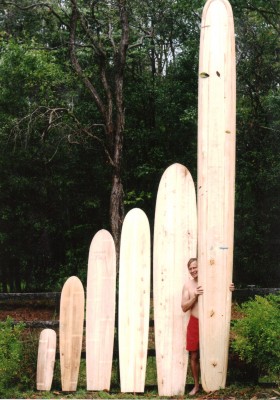 Alaia quiver 1
For the next two years Jacob and I were obsessed with figuring out how the alaia works. The ancients had surfed the alaia in heavy waves like Sunset Beach. How did they shape the boards so they would surf those waves? We slowly began to unlock the secrets with endless experimentation. I would start by making a big alaia that was very heavy and difficult to paddle and then shape it down over and over until it was a small bellyboard. The first secret was flex. The board would hang in a steep pocket if it flexed. There was a proper flex which seemed magical. Too much or too little and the board did not work well. One other evolution happened by accident. Jacob's favourite board twisted or cupped a bit. The rounded board now had a concave through the bottom. I said I would shape it out to make the bottom round again but Jacob said it surfed better with the concave.
The next evolution came when we were studying this photograph, below.
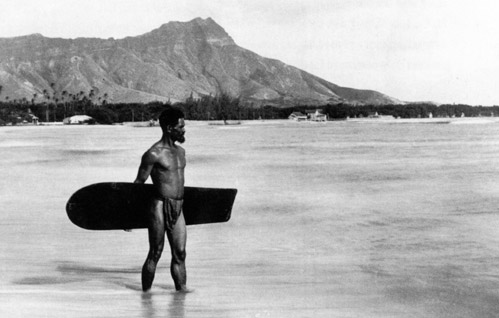 Waikiki 1890
I had just glued up a 9'1 alaia blank for Jacob and we were thinking about the shape. Again, we were still perplexed with how the alaia could hold into a steep face. When looking at this photo we could see that the Hawaiian was a real surfer. You can just tell by his stance. Jacob noticed that the tail was not flat and it looked like that because there is a concave! Then we started to look at the template and we noticed that the rails were parabolic. The tail flares out just a little, like a modern snowboard. Wow! That was it. We copied the ancient board as best we could and that afternoon Jacob was ripping across the points with a new grace and confidence in the steep fast waves.
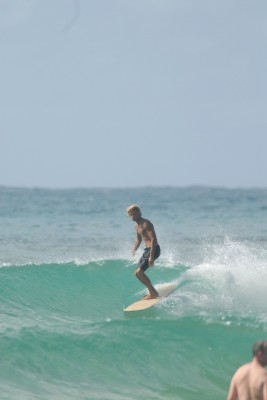 Jacob Stuth pic by Nigel Arnison
From there the alaia story grew and grew. At that time there was only Jacob and I. Soon there were top surfers taking up the challenge and Thomas Campbell and Nathan Oldfield were hot to film them. There was a little explosion of excitement. In 2009 Surfing Magazine named me Shaper of the Year for bringing back the alaia. Now the alaia is a common board with its own division in the Australian National Titles. It has been a dream come true for me to see the alaia reassert itself as a great surfboard.
Philosophy of the Alaia – Step light, stand tall
The alaia is a very environmentally friendly surfboard. It comes from plantation grown trees, often organically grown, and available in more and more countries. The unused parts of the tree are mulched and on-sold and the leaves are fed to cattle. Manufacturing the soft, light timber uses a minimal amount of fossil fuel energy and the only petrochemical by-products in the finished surfboards are found in the small amount of glue used. The surfboard is sealed with linseed oil, gum turpentine and bees wax. When it has finally come to the end of its use it disappears back into the earth. In this way this surfboard steps lightly on the planet.
In ancient times kids learned to ride waves on the shortest surfboards. This way they learned swimming skills and how to work with broken waves. As the surfers progressed in skill they moved to longer surfboards and learned to stand on them. It is unlikely that anyone of our time will fully comprehend how good the ancients could surf, but from what I have seen in my years of riding the alaia, I suspect that the ancients were impressive, to say the least. Now, people start surfing on long boards that are very easy to ride. Angling is simple with a finned board and skill is thoroughly compromised with the leash.
Riding the alaia, the surfer is in a totally different mindset. You feel so much closer to the natural environment. The surfing is on a more universal scale. On modern equipment you may catch more waves and feel like you “rip,” but are you surfing better? Better than what? Riding the alaia brings a new level of difficulty which, at the outset, turns most people off. But lots of the world’s best surfers find that this brings more excitement and joy to surfing. When surfing the alaia you are more eye to eye with nature and standing tall.
The alaia surfboard will last many years, if cared for. Each one is worthy of a name, but it disappears without a trace in the end.
The shape is so simple that it is hard to see how the surfboard works, but each curve is of maximum importance. Each milli-meter of roll, concave, thickness and curve makes a big difference to how the alaia rides. This surfboard needs care with oiling and sometimes some sanding or repair work, but it will take a lot of abuse and can last a lifetime. A good surfboard is of great value because you can get so many years of enjoyment from it. An alaia, which you can love for a long time and then bury, can be relatively inexpensive at the outset.
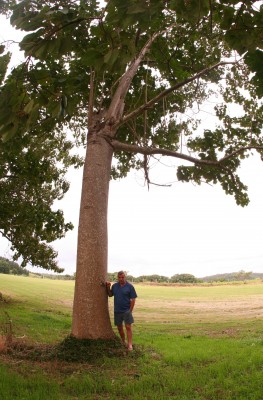 The Paulownia tree
The Alaia Story DVD
Within weeks of the first rides of the alaia I was obsessed. I thought our discovery was really important so I bought a video camera and an editing program and started documenting our findings. I finished it when I thought we had a good understanding of the boards. That was October 2007. Since then I really developed the different models of the Stuth and the Peanut alaias, but the development of the boards in these three clips is fascinating.
## **The Finley Model Alaia**This is a template that I copied from the ancient alaia surfboards in the Bishop Museum. It is the best all around shape for standing on as well as riding prone. This is the fastest shape with the straight rails and wide tail.
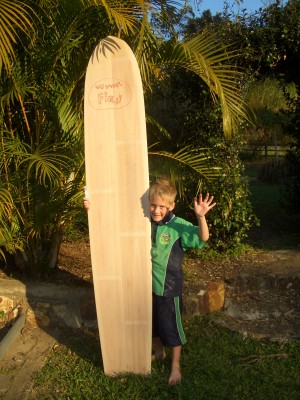 Young, school boy Fin 2005
The boards in the Museum do not have concaves, but I found they ride better with a light concave. The concave gives a better flex and more control. I named the board after my son, Finley because I made a board for him and then took it out for a surf myself. I could not believe how fun it was to surf! Before then the boards were over 9’ long. This board proved the dimension of the alaias that the early missionaries to Hawaii saw were right on, about head high, 16 inches wide, and no thicker than your finger.
I do not think the Hawaiians made such a big distinction between riding prone and standing up. Prone surfing is faster because you can bend the board with your body to get reverse rocker which is definitely faster! Standing gives you a lot more manoeuvrability.
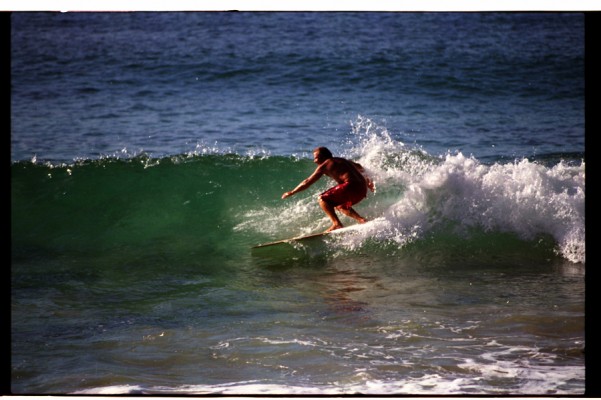 Tom Wegener by Ryan Heywood on Finley's board
I make these boards from 4′ to 9’ long and 13’ to 18” wide. The thickness depends on the size of the rider – for the flex. In stock I almost always have a 6’ x 16” x ¾ in. This is the most standard size. Even a big person can stand up on it on a good wave though it is a too big for person under 50 kilos.
I once went on a trip through Japan and Taiwan and I only took two Finley models, a 5’5” and a 6’0”. I thought they were perfect and I surfed from small waves to prone, riding giant typhoon tubes. The longer boards, above 7 feet, are tricky. Longer does not make them easier to ride or paddle! This was the huge lesson to learn about the alaia. None are easy to paddle. The longer they are the more volume you have to push through the water. The shorter alaias you can paddle fast in short bursts and get the board on a planing surface. The long ones never get to plane and often just don’t let you into a wave. You either miss it or go over the falls.
For the person that wants to find alaia surfing, the Finley model is the best. For the older surfer it is really nice to be able to take off prone and set your edge. Once you have control and are flying across the wave you can easily jump to your feet. However, if you are like me you will find that riding prone in small waves is super fun.
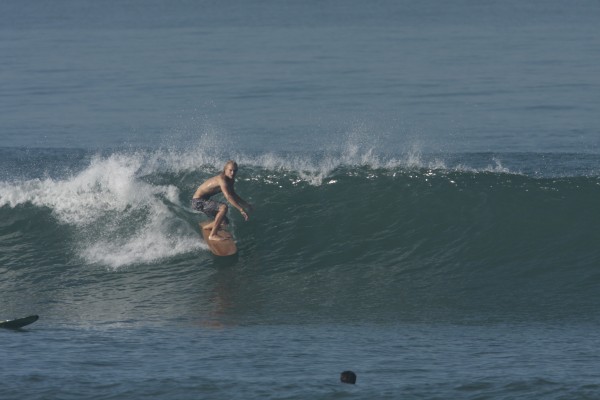 Remi Peterson in trim on surfing a Finley Model Alaia in Bali
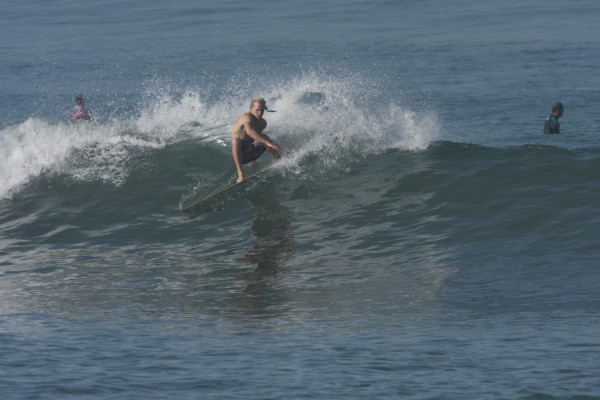 Remi Peterson cuts back on a Finley Model Alaia
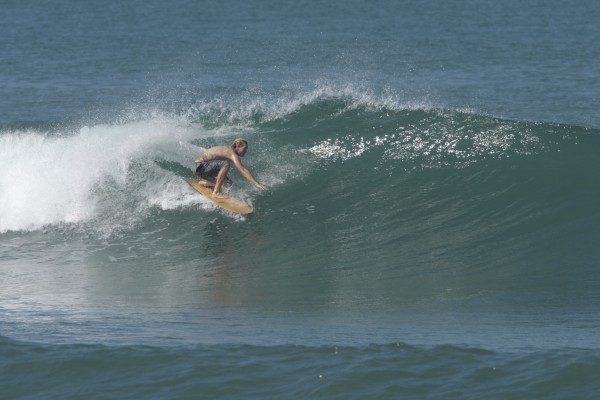 Remi Peterson trimming under the lip on a Finley Model Alaia
Remi Peterson is a great surfer from South Africa. He borrowed an alaia from the Drift Surf Shop in Bali and proceeded have a lot of fun! The Finley Model in trim is very fast.
The Stuth Model Alaia
The Stuth alaia is the model based on the Hawaiian photo. I called it the Stuth because Jacob Stuth was the first to see that the board in the photo had parabolic rails and concave.
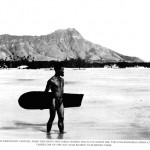 The famous photo from the 1800′s: Parabolic rails and concave
The first Stuth alaia shapes were from 9’ to 12’ long. We struggled with them a bit and at the time we were still riding the few shorter Finley or traditional alaia outlines. This is when Thomas Campbell was shooting 'The Present' in Africa. There was a Stuth model on the trip, but the two classic alaia shapes made it into the movie. David Rastovich called me when he came back and said if I could make an alaia that would tube ride and cut back then he would transfer to the alaia. The pressure was on!
A few months later David called and said he was off to Hawaii in two days to ride the alaia. By that time the shapes had evolved and I had to get him another board. I shaped one that night and drove it to him the next day. The board was very thin, 6’6”, with lots of concave. It was first board I made with a new understanding of how the alaia surfed. He went to Hawaii and he was tube riding and cutting back. The alaia revolution was on.
This is the board I made for David. This was the first surfboard with this bottom shape for over 100 years. Being so thin and in Hawaiian conditions, the board cracked several times. I fixed it over and over. In Campbell’s film, 'The Present', Rasta pulls a mean cutback at Sunset on this board.
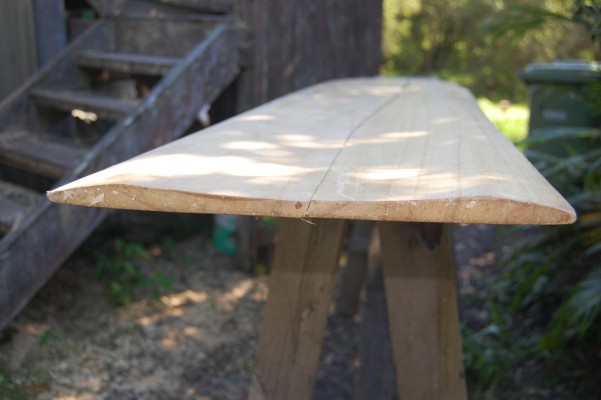 Rasta's tail: The first thin, deep concave, parabolic railed alaia from paulownia
The parabolic rail holds the board into the wave better than the straight or regular curved rail. The deep concave lets the board grab into the wave more. The benefit is you get a lot more control and ability to hang in a steep face. They tube ride well. The down side is they are a little slower and do not ride prone like the Finley shape. I make these from 5”5’ to 7’0” and 16’ to 17” wide. The deep concave makes them more prone to cracking than the other boards so I am especially careful with the wood I use. I have found certain cuts that flex more and crack less than others.
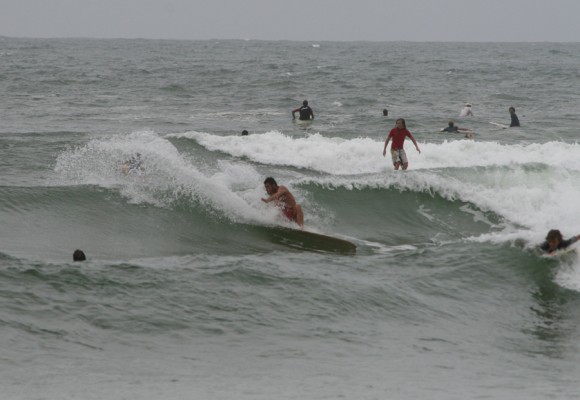 Photo by David Pecchi
Rasta cutting back on the above alaia. He had just come back from Hawaii and showed us what he was up to.
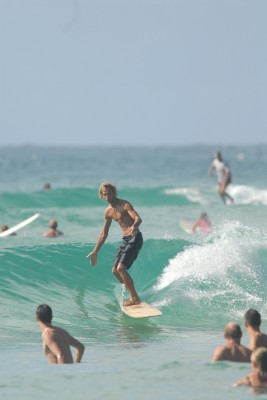 Jacob side slip photo by Nigel Arnison
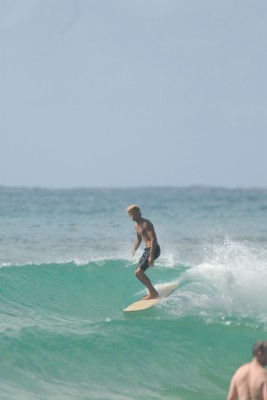 Jacob in trim, Noosa by Nigel Arnison
These photos came from the day Jake and I made the first parabolic railed board. We made the tail flair out just like the board the Hawaiian was holding. We put a concave in as well as made it thin enough to flex. It was 9’3 which we thought was really short! It was another year before be brought them down to 6’6. It was a lightbulb moment for us and I remember every detail of the day. Jake and I shaped it and he took it out an hour later and Nige got these shots. Jake had far more control than before. We felt we were a lot closer to figuring out the mysteries of ancient Hawaiian surfing.
The Peanut Model Alaia
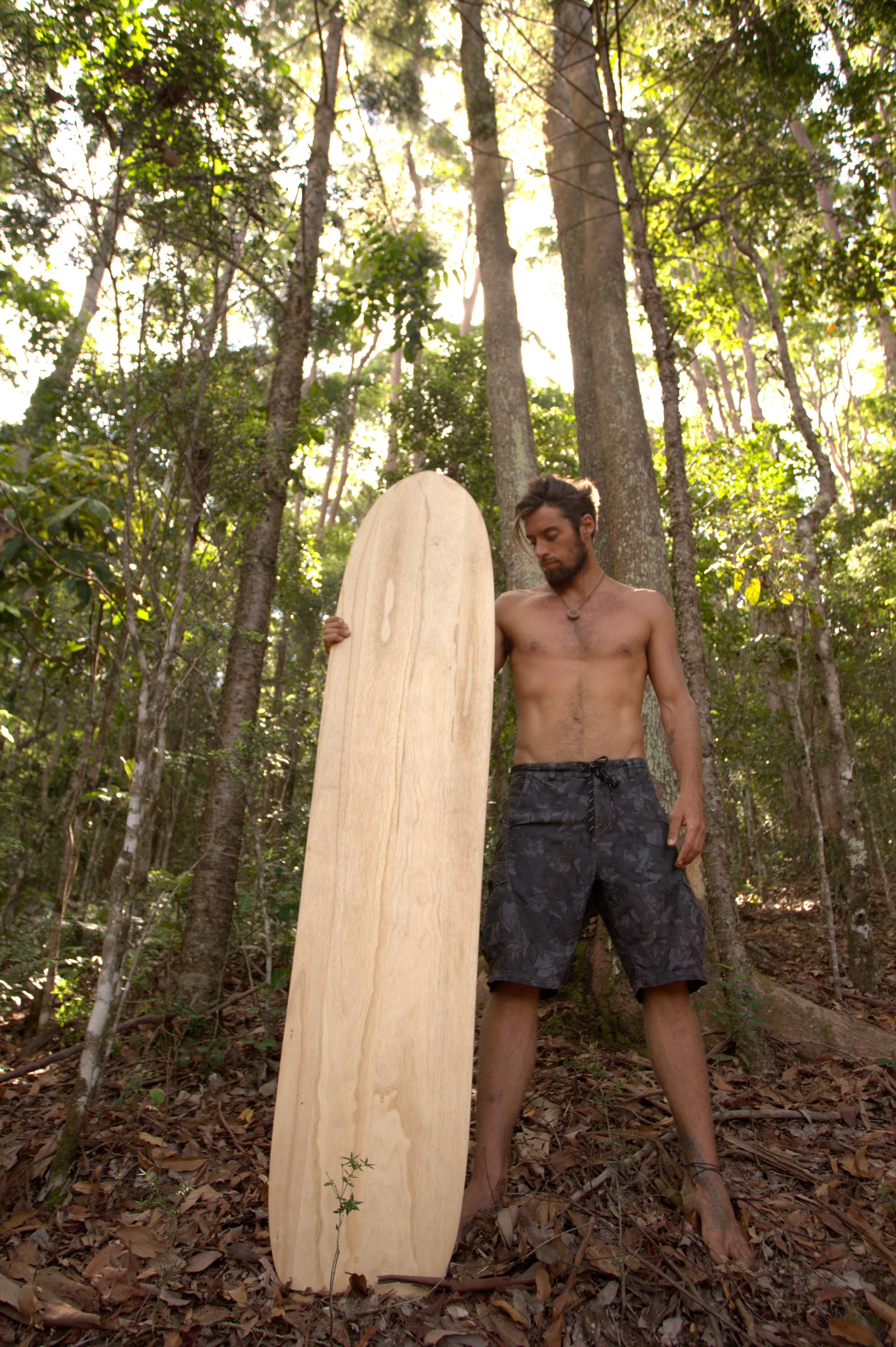 I made this Peanut for David Rastovich and he paddled it out a few minutes later and got this wave:
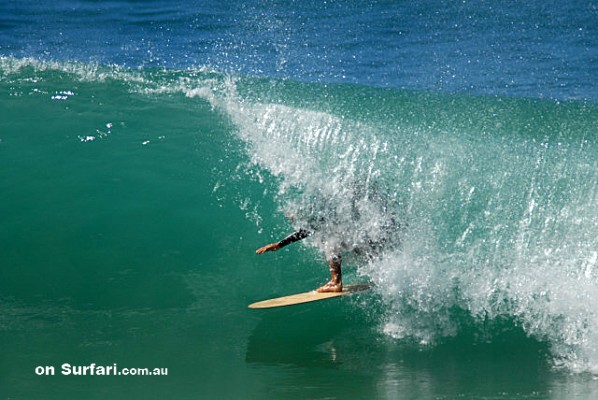 Jacob Stuth’s cover at Yaroomba by Nigel Arnison 2008
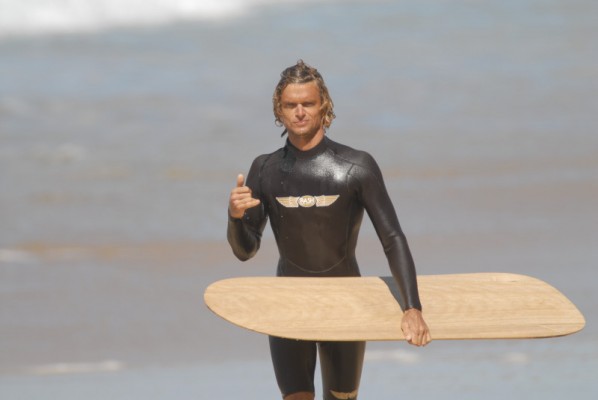 Jake on the beach at Yaroomba
Jake is pretty happy with the 5’7 Peanut. He instinctively grabbed the board and rode it for nearly a year. He loved it. I ended up bringing it to California for the 2009 Sacred Craft show in San Diego. My brother Jon and I had a stack of alaias at our little booth when Rob Machado came by. He had got some legendary waves at Uluwatu on a board that Jon have given to him through Thomas Campbell. Jon and I said, here is our latest quiver, take what you want. He took the peanut. He surfed it the next day and was super stoked. Next he was in 'The Present' on it. When the movie premiered in Australia I gave a new single slab Peanut to Jacob, alaia #200 and he still surfs it.
The original 5’7” shape is the most difficult alaia to surf by far. You have to come off the bottom front footed only. Also, 5’7” is short. I have made the board longer to make it easier but it will still slide and spin easily.
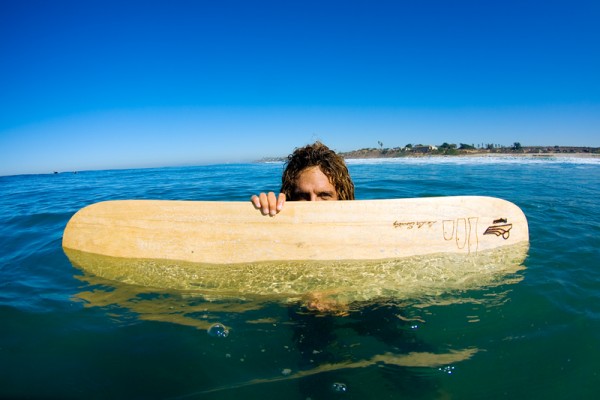 Rob Machado hides behind a peanut
Rob Machado with the first Peanut that I cut down from the 12 footer. I brought it to San Diego for the Sacred Craft show and Rob picked it up from there to give it a try.
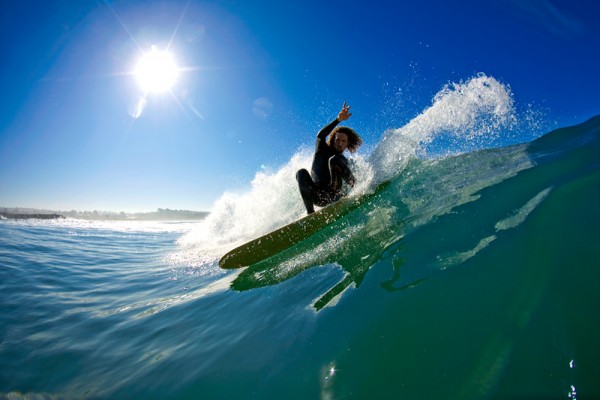 Rob Machado cut back
The top surfers like Rob here are so good at surfing. This is the first Peanut. He ended up in the movie The Present riding it just like this at little Pipeline. He is truly amazing!